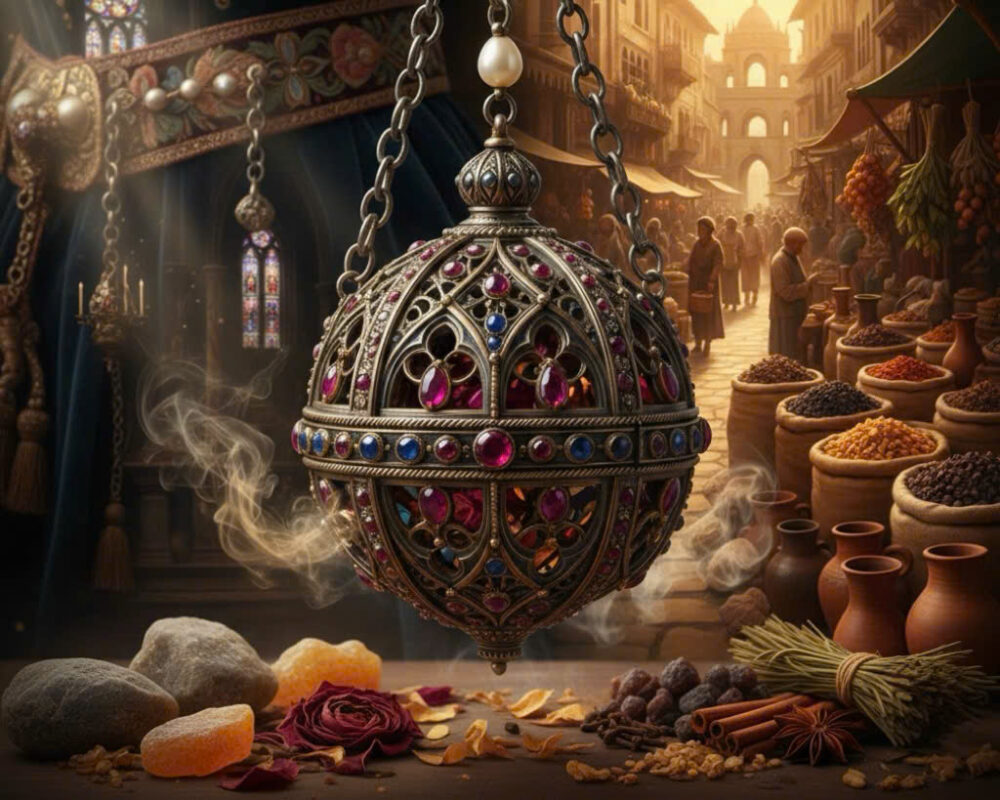
In the tapestry of medieval history, fragrance was far more than a vanity; it was a profound necessity, a mystical shield, and an unmistakable declaration of power. Long before the era of modern glass flacons, the air of the royal courts was scented not by sprays, but by the Pomander—an exquisite, often jewel-encrusted vessel that held the olfactory secrets of an era defined by both extreme luxury and looming shadows.
The Origins: The “Apple of Amber”
The word “pomander” finds its roots in the Old French pomme d’ambre, literally translating to “apple of amber.” This was a reference both to its spherical shape and to one of its most prized ingredients: ambergris. These objects first gained prominence in the 13th century as personal, portable perfume diffusers. Crafted from gold, silver, or high-quality brass, pomanders were often intricately engraved with gothic motifs or openwork filigree, allowing the potent scents within to waft into the wearer’s surroundings.
For the medieval elite, the pomander was a constant companion. It hung from neck chains, dangled from “girdles” (elaborate belts), or was held in the hand during public appearances. It was the “scent-armor” of the aristocracy, separating the noble-born from the harsh, unwashed realities of the medieval street.
A Royal Obsession: The Shield of Queen Elizabeth I
To understand the true weight of the pomander, one must look at the legendary Queen Elizabeth I. Historical accounts and portraits often depict her with a pomander suspended from her waist. In a time when the “Miasma Theory” prevailed—the belief that diseases like the Black Death were spread through “foul air“—the Queen’s pomander was her primary line of defense.
Legend has it that Elizabeth I was particularly fond of a pomander composed of rosewater, labdanum, benzoin, and ambergris, mixed with deer musk. It was more than a perfume; it was a medicinal amulet. By inhaling the rich, spicy vapors, she believed she was purifying the air entering her lungs, literally “perfuming away” the plague. For the Queen, to be scented was to be safe, and to be safe was to be powerful.
The Olfactory Alchemy: A Deeper Scent Profile
The contents of a medieval pomander were not light or fleeting. They were dense, resinous, and deeply evocative, designed to last for months. To recreate the scent of a 14th-century pomander is to walk through a dark, incense-filled cathedral or a bustling spice market on the Silk Road.
- The Resinous Heart (Frankincense & Myrrh): These were the “tears” of the gods. Frankincense provided a cold, ethereal citrus-pine note that spoke of spirituality, while Myrrh added a bitter, earthy depth that grounded the fragrance.
- The Spicy Shield (Clove & Cinnamon): These were the world’s most expensive commodities. Clove offered a sharp, medicinal heat, while Cinnamon provided a dry, woody warmth. Together, they created a “fire” that was believed to burn away infection.
- The Animalic Soul (Ambergris & Musk): These ingredients were the fixatives. Ambergris, with its salty, oceanic, and tobacco-like sweetness, gave the scent a regal “glow.” Musk added a primal, warm skin-like quality that ensured the fragrance would linger on heavy velvet robes for weeks.
- The Botanical Grace (Rose & Lavender): Often added to soften the harshness of the spices, these floral waters provided a fleeting, delicate top note that symbolized purity and divine favor.
The Modern Pomander: Medieval Spirit for the 21st Century
At Febamourst, we believe that the modern world is just as chaotic as the medieval one. While we no longer fear the “miasma,” we still seek the same things the knights and ladies of old desired: a sense of identity, a moment of calm, and a lingering aura that commands respect.
Our Medieval Collection is a tribute to the alchemy of the pomander. We have meticulously sourced the same ancient resins and rare spices—from the smoky depths of Labdanum to the spicy bite of Clove—to create fragrances that do more than just smell good. They provide an “olfactory sanctuary.”
When you wear our Unisex Medieval Scents, you are not just wearing a perfume; you are donning an invisible piece of jewelry. You are carrying the legacy of the “Apple of Amber” into the modern day. Whether you prefer the masculine strength of spiced wood or the feminine mystery of dark roses and musk, our collection offers a bridge to a time when scent was a matter of life, death, and undeniable glory.
Why Choose a Medieval-Inspired Fragrance?
- Unrivaled Longevity: Like the solid perfumes of old, our resin-heavy bases ensure your scent lasts from dawn until dusk.
- Unique Identity: Move away from mass-market floral scents and embrace the complex, “dark” profiles of the Middle Ages.
- Genderless Elegance: True to historical roots, our scents are designed for the individual, not the gender.
Experience the mystery of the past today.
